These findings potentially resolve a discrepancy in research related to the effect of exercise on the brain — namely that exercise reduces anxiety while also promoting the growth of new neurons in the ventral hippocampus. Because these young neurons are typically more excitable than their more mature counterparts, exercise should result in more anxiety, not less. The Princeton-led researchers, however, found that exercise also strengthens the mechanisms that prevent these brain cells from firing.
…
From an evolutionary standpoint, the research also shows that the brain can be extremely adaptive and tailor its own processes to an organism’s lifestyle or surroundings, Gould said. A higher likelihood of anxious behavior may have an adaptive advantage for less physically fit creatures. Anxiety often manifests itself in avoidant behavior and avoiding potentially dangerous situations would increase the likelihood of survival, particularly for those less capable of responding with a “fight or flight” reaction, she said.
…
The anxiety-reducing effect of exercise was canceled out when the researchers blocked the GABA receptor that calms neuron activity in the ventral hippocampus.
Interesting research (with mice) that explores how exercise makes us more resilient to stress. I know for me, exercise seems to help relieve stress.
The fact that an increasing number of medications are unable to beat sugar pills has thrown the industry into crisis. The stakes could hardly be higher. In today’s economy, the fate of a long-established company can hang on the outcome of a handful of tests.
…
Potter discovered, however, that geographic location alone could determine whether a drug bested placebo or crossed the futility boundary. By the late ’90s, for example, the classic antianxiety drug diazepam (also known as Valium) was still beating placebo in France and Belgium. But when the drug was tested in the US, it was likely to fail. Conversely, Prozac performed better in America than it did in western Europe and South Africa. It was an unsettling prospect: FDA approval could hinge on where the company chose to conduct a trial.
…
In one study, Benedetti found that Alzheimer’s patients with impaired cognitive function get less pain relief from analgesic drugs than normal volunteers do. Using advanced methods of EEG analysis, he discovered that the connections between the patients’ prefrontal lobes and their opioid systems had been damaged. Healthy volunteers feel the benefit of medication plus a placebo boost. Patients who are unable to formulate ideas about the future because of cortical deficits, however, feel only the effect of the drug itself. The experiment suggests that because Alzheimer’s patients don’t get the benefits of anticipating the treatment, they require higher doses of painkillers to experience normal levels of relief.
Benedetti often uses the phrase “placebo response” instead of placebo effect. By definition, inert pills have no effect, but under the right conditions they can act as a catalyst for what he calls the body’s “endogenous health care system.” Like any other internal network, the placebo response has limits. It can ease the discomfort of chemotherapy, but it won’t stop the growth of tumors. It also works in reverse to produce the placebo’s evil twin, the nocebo effect. For example, men taking a commonly prescribed prostate drug who were informed that the medication may cause sexual dysfunction were twice as likely to become impotent.
…
Moreover, a pill’s shape, size, branding, and price all influence its effects on the body. Soothing blue capsules make more effective tranquilizers than angry red ones, except among Italian men, for whom the color blue is associated with their national soccer team—Forza Azzurri!
Medical research presents significant difficulties. The funding of the health care system also distorts behavior and pushes companies to focus on being able to justify selling drugs instead of focusing on finding effective solutions. Even without incentives distorting behavior, the challenges are difficult enough. Adding the distortions just makes it worse.
It is wonderful we have so many scientists accepting these challenges and spending their careers fighting the odds to help find us wonderful health breakthroughs.
We need more medical solutions that serve the majority of humanity instead of just the rich. Some medical research is innately costly and therefore require large costs to pay back the investment. But too little concern is shown for solutions that help people (with so much focus only on solutions that will make organizations rich).
This low-tech visual exam cut the cervical cancer death rate by 31 percent, the study found. It could prevent 22,000 deaths in India and 72,600 worldwide each year, researchers estimate.
…
More progress against cervical cancer may come from last month’s announcement that two companies will drastically lower prices on HPV vaccines for poor countries. Pilot projects will begin in Asia and Africa; the campaign aims to vaccinate more than 30 million girls in more than 40 countries by 2020.
India continues to invest in medical research for solutions that are affordable to a majority of the world. The rich health care companies largely neglect the majority to focus on the most wealthy.
Tim Noakes is the Director of UCT/MRC Research Unit for Exercise Science and Sports Medicine, Department of Human Biology, Faculty of Health Science, University of Cape Town and Professor, Discovery Health Chair of Exercise and Sports Science, University of Cape Town.
Tim examines some questions on science and exercise and health in the webcast. He shows the problem with drinking too much during exercise and the correlation of hospital admissions correlated to the sport drinks marketing and changing of the official drinking guidelines. He also discusses the outdated ideas related to lactic acid and muscles.
He is currently studying the science of food and human health and is skeptical of low fat health claims: “No evidence that dietary fat is related to heath disease.” He is certainly more knowledgable than I but I would still be cautious of completely accepting that premise. It does seem to me there is lots of evidence that claims of causation between eating a high fat diet and heart disease were too strong (many other factors were critical – such as weight, exercise, genetics, unsaturated fat v. saturated fat…).
Tim Noaks: “50% of what we teach is wrong; the problem is we don’t know which 50% it is. Our job as educated people is to spend our lifetime trying to figure out which 50% is which. Until it is disproven accept that for which the evidence appears solid and logical and is free of covert or overt conflicts of interest, because unfortunately industry is driving what you believe in many many things. But don’t ever dismis lightly that for which there is credible evidence… and there is such clear evidence the diets we are eating are horrendous.”
When cells divide the process fails to copy DNA all the way to the end. Telomeres are are the end of DNA strands, as essentially a buffer of material that won’t cause information to be lost when part of the telomere isn’t copied. As DNA is copied, as new cells are created, the length of telomeres at the end is reduced. Once the telomeres are gone the cell will no longer divide.
The 2009 Nobel Prize in Physiology or Medicine went to 3 scientists for discovering how the chromosomes can be copied in a complete way during cell divisions and how they are protected against degradation. The Nobel Laureates have shown that the solution is to be found in the ends of the chromosomes – the telomeres – and in an enzyme that forms them – telomerase.
There is some debate over the benefit of the mechanism of cells not dividing do to lack of telomere. This can prevent cancerous cells from replicating (once they replicate to the extent that the necessary telomere buffer is gone). It is also seen that as telomeres get shorter the cells become more likely to become cancerous.
Cancer also can stimulate the production of telomerase which can stop telomeres from getting shorter as cells divide and thus allow the cancer cells to keep dividing (thus producing more cancer cell and increasing the amount of cancerous cells). Using telomerase to allow health cells to avoid the limits of division is being researched.
An enzyme named telomerase adds bases to the ends of telomeres. In young cells, telomerase keeps telomeres from wearing down too much. But as cells divide repeatedly, there is not enough telomerase, so the telomeres grow shorter and the cells age.
…
Cells normally can divide only about 50 to 70 times, with telomeres getting progressively shorter until the cells become senescent, die or sustain genetic damage that can cause cancer.
…
shorter telomeres are associated with shorter lives. Among people older than 60, those with shorter telomeres were three times more likely to die from heart disease and eight times more likely to die from infectious disease.
While telomere shortening has been linked to the aging process, it is not yet known whether shorter telomeres are just a sign of aging – like gray hair – or actually contribute to aging.
Untreatable and hard-to-treat infections from Carbapenem-resistant Enterobacteriaceae (CRE) germs are on the rise among patients in medical facilities. CRE germs have become resistant to all or nearly all the antibiotics we have today. Types of CRE include Klebsiella pneumoniae Carbapenemase (KPC) and New Delhi metallo-beta-lactamase (NDM). By following the United States Center for Disease Control (CDC) guidelines, we can slow the penetration of CRE infections in hospitals and other medical facilities and potentially spread to otherwise healthy people outside of medical facilities.
The CDC has worked with hospitals to successfully apply these measures. The CDC worked with Florida to stop a year-long CRE outbreak in a long-term acute care hospital. With the improved use of CDC recommendations (such as educating staff; dedicating staff, rooms, and equipment to patients with CRE; and improving use of gloves and gowns) the percentage of patients who got CRE at the facility dropped from 44% to 0.
One travesty has been how poorly health care professionals have been about prescribe antibiotics wisely We need to improve and follow CDC antibiotics guidelines (stop the overuse of antibiotics) and use culture results (for patients undergoing treatment) to modify prescriptions, if needed. Antibiotic overuse contributes to the growing problems of Clostridium difficile (c-diff) infection and antibiotic resistance in healthcare facilities. Studies indicate that nearly 50% of antimicrobial use in hospitals is unnecessary or inappropriate (per CDC web site).
Israel decreased CRE infection rates in all 27 of its hospitals by more than 70% in one year with a coordinated prevention program. The USA is at a critical time in which CRE infections could be controlled if addressed in a rapid, coordinated, and consistent effort by doctors, nurses, lab staff, medical facility leadership, health departments/states, policy makers, and the federal government.
As I have been saying for years the damage we are creating due to our actions around the use and abuse of antibiotics is likely to kill tens of thousands, or more people. Because the deaths are delayed and often not dramatic we have continued dangerous practices for years when we know better. It is a shame we are condemning so many to increased risks. The CDC, and others, are doing good work, unfortunately too much bad work is continuing in the face of evidence of how dangerous that is.
…Glucose lowered the activity of the hypothalamus but fructose actually prompted a small spike to this area. As might be expected from these results, the glucose drink alone increased the feelings of fullness reported by volunteers, which indicates that they would be less likely to consume more calories after having something sweetened with glucose than something sweetened with more fructose.
Fructose and glucose look similar molecularly, but fructose is metabolized differently by the body and prompts the body to secrete less insulin than does glucose (insulin plays a role in telling the body to feel full and in dulling the reward the body gets from food). Fructose also fails to reduce the amount of circulating ghrelin (a hunger-signaling hormone) as much as glucose does. (Animal studies have shown that fructose can, indeed, cross the blood-brain barrier and be metabolized in the hypothalamus.) Previous studies have shown that this effect was pronounced in animal models…
Most of the science indicates calories consumed is by far the dominant factor in weight gain. Different foods with the same calories can affect how hungry you feel. Thus the biggest factor in reducing weight gain seems to be reducing calories and one way to help is to eat food that leaves you feeling full and avoid foods that don’t.
The science is not completely clear though on whether certain diets can have a significant affect above and beyond calorie levels. I am skeptical of such claims, however. There are concerns beyond calories for healthy eating – getting a well balanced diet is important.
Healthy physical activity is also important. Burning off calories with exercise allows more consumption without weight gain. And exercise is important for health not just to avoid gaining weight.
Not only did the team find that evidence for Infuse’s benefits over existing alternatives for most patients was questionable; they also discovered in a broad array of published research that risks of complications (including cancer, male sterility and other serious side effects) appeared to be 10 to 50 times higher than 13 industry-sponsored studies had shown. And they learned that authors of the early studies that found no complications had been paid between $1 million and $23 million annually by the company for consulting, royalties and other compensation. Carragee, MD ’82, estimates Medtronic has sold several billion dollars’ worth of Infuse for uses both approved and “off label.”
…
Without a rigorous, data-driven context, medicine’s expensive traditions and hunch-based treatments threaten to bankrupt us. “People say that we shouldn’t delay science; people are dying; we should get new treatments out there. I do not feel the pressure to do that until we have solid evidence,” Ioannidis asserts. “The resources many procedures draw are enormous.” And that leaves insufficient funds for the prevention plans and treatments we know actually work.
I have written about the problems with our health care research system several times. The existing system is in need of improvement and is made much worse by the general state of the broken health care system in the USA. Dr. John P.A. Ioannidis, the focus of the article, is doing fantastic work in this area.
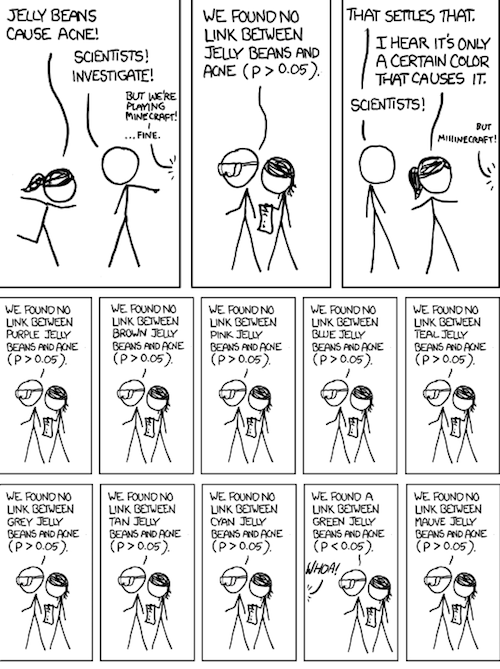
The changes in cancer risk were all over the map: 39 percent found an increased risk, 33 percent found a decreased risk and 23 percent showed no clear evidence either way.
…
The vast majority of those studies, Schoenfeld and Ioannidis found, showed really weak associations between the ingredient at hand and cancer risk. A full 80 percent of the studies had shown statistical relationships that were “weak or nominally significant,” as measured by the study’s P-values. Seventy-five percent of the studies purporting to show a higher cancer risk fell into this category, as did 76 percent of those showing a lower cancer risk.
Sadly the evidence is often not very compelling but creates uncertainly in the public. Poorly communicated results and scientific illiteracy (both from publishers and the public) leads to more confusion than is necessary. Even with well done studies, good communication and a scientifically literate population nutrition and human health conclusion are more often questionable than they are clear.
Science provide the opportunity for us to achieve great benefits for society. However, especially in medical research money can make what are already very difficult judgments even less reliable. Add that to a very poor understanding of science in those we elect and you have a dangerous combination. That combination is one of the largest risks we face and need to manage better. I wish we would elect people with a less pitiful appreciation for science but that doesn’t seem likely. That makes doing a better job of managing the conflicts of interest money puts into our current medical research a top priority.
In the past few years the pharmaceutical industry has come up with many ways to funnel large sums of money—enough sometimes to put a child through college—into the pockets of independent medical researchers who are doing work that bears, directly or indirectly, on the drugs these firms are making and marketing. The problem is not just with the drug companies and the researchers but with the whole system—the granting institutions, the research labs, the journals, the professional societies, and so forth. No one is providing the checks and balances necessary to avoid conflicts.
…
Peer-reviewed journals are littered with studies showing how drug industry money is subtly undermining scientific objectivity. A 2009 study in Cancer showed that participants somehow survived longer when a study’s authors had conflicts of interest than when the authors were clean. A 1998 study in the New England Journal of Medicine found a “strong association” between researchers’ conclusions about the safety of calcium channel blockers, a class of drugs used to reduce blood pressure, and their financial relationships with the firms producing the drugs.
Most of those in the system have an interest in minimizing an effort to clean this up. It is just more work they don’t want to do. Or it goes directly against their interest (drug companies that want to achieve favorable opinions by buying influence). The main political message in the USA for a couple decades has been to reduce regulation. Allowing research that is tainted because you find regulation politically undesirable is a bad idea. People that understand science and how complex medical research is appreciate this.
Sadly when we elect people that by and large are scientifically illiterate they don’t understand the risks of the dangerous practices they allow. Even if they were scientifically illiterate but understood their ignorance they could do a decent job by getting scientific consultation from experts but they don’t (to an extent they listen to the scientists that those that give them lots of money tell them to which does help make sure those giving the politicians cash have their interests served but it is not a good way to create policy with the necessary scientific thinking needed today).