Author Archives: curiouscat

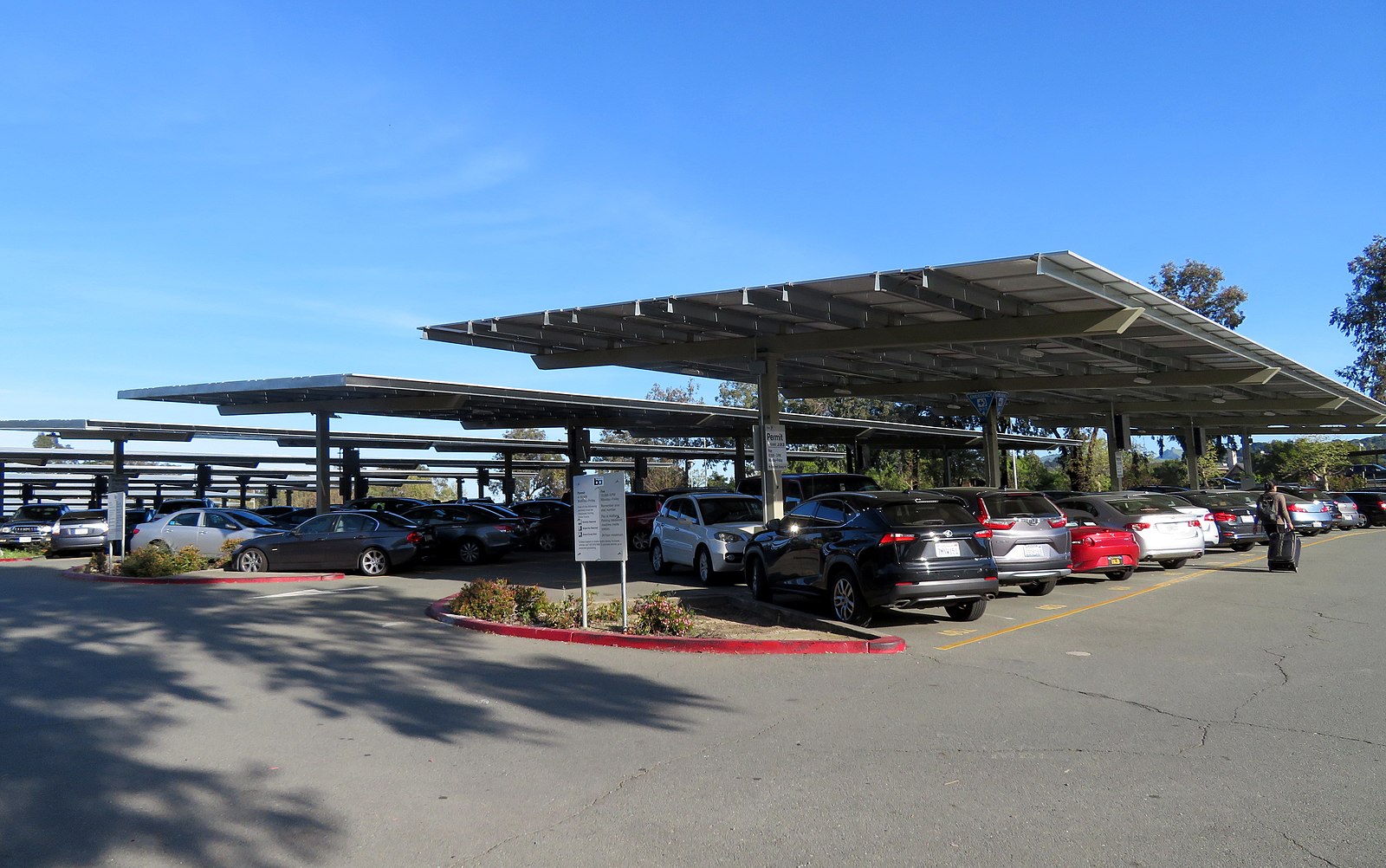
We Should Put Solar Panels Above Parking Lots

Why Putting Solar Canopies on Parking Lots Is a Smart Green Move

A typical Walmart supercenter, for instance, has a five-acre parking lot, and it’s a wasteland, especially if you have to sweat your way across it under an asphalt-bubbling sun. Put a canopy over it, though, and it could support a three-megawatt solar array… the canopy would [also] shade customers… If Walmart did that at all 3,571 of its U.S. super centers, the total capacity would be 11.1 gigawatts of solar power — roughly equivalent to a dozen large coal-fired power plants.

image of parking lot with solar panels above it

Solar panels atop the upper parking lot at Lafayette station, California (via wikimedia).

It is more expensive to build the solar arrays and infrastructure above existing parking lots (compared to an empty field) but it is a great use to space. We should be encouraging such development.

Related: Molten Salt Solar Reactor Approved by California (2010)Large Scale Redox Flow Battery (2017)Appropriate Technology: Solar Water in Poor Cairo Neighborhoods

Update (added March 2023) – Solar power can be a land-hungry competitor to farming. But deployed in the right way, solar installations can boost crop yields, save water, and protect biodiversity (USA National Academy of Sciences report).

Alzheimer’s and the Complex Scientific Inquiry Process

This webcast provides an interesting look at the complex scientific inquiry process: An Alzheimer’s Drug That Doesn’t Treat Alzheimer’s?

Medical research is complex. Once we figure out what is most critical and discover effective treatments often the explanations can then make it seem fairly simple. But that process is often decades of efforts that include years of frustration and confusion.

For long term medical impacts we often need to guess at important biomarker indications that may be closely related to health outcomes. But that process often isn’t as easy as it sounds.

Much Alzheimer’s research for the last few decades has focused on amyloid plaque reduction.

A new Alzheimer’s drug has been approved. But should you take it?

Aducanumab (brand name Aduhelm) is a monoclonal antibody engineered in a laboratory to stick to the amyloid molecule that forms plaques in the brains of people with Alzheimer’s. Most researchers believe that the plaques form first and damage brain cells, causing tau tangles to form inside them, killing the cells. Once aducanumab has stuck to the plaque, your body’s immune system will come in and remove the plaque, thinking it’s a foreign invader. The hope and expectation are that, once the plaques are removed, the brain cells will stop dying, and thinking, memory, function, and behavior will stop deteriorating.

Related: The Amazing Reality of Genes and The History of Scientific InquiryScientific Inquiry Leads to Using Fluoride for Healthy TeethIntroduction to Fractional Factorial Designed ExperimentsBenefits of a Mediterranean Diet May Include Reduced Risk of Cognitive Impairment As We Age

mRNA Vaccine Targets Ticks to Allow Us to Avoid Diseases Ticks Carry

A lab-stage mRNA vaccine targeting ticks may offer protection against Lyme and other tick-borne diseases

A new laboratory-stage mRNA vaccine that teaches the immune system to recognize the saliva from tick bites could prevent these bugs from feeding on and transmitting tick-borne diseases to people

What’s unique about the 19ISP mRNA vaccine is that instead of directly targeting the pathogen that causes the disease like traditional vaccines, 19ISP was able to stimulate resistance to the carrier of the disease, ticks, and prevent them from transmitting the pathogen in the first place. Our study also suggests that this form of tick-based vaccination – teaching the body to rapidly recognize and react to being bitten by a tick – may be sufficient to prevent infection.

mRNA vaccines have been in the news a great deal due to the covid19 mRNA vaccines. The potential for mRNA solutions is very promising. If this research can be confirmed and brought to market it could save us from Lyme disease and other diseases transmitted via ticks.

Related: New and Old Ways to Make Flu Vaccines (2007)Vaccines Can’t Provide Miraculous Results if We Don’t Take ThemScientific Illiteracy Leads to Failure to Vaccinate Which Leads to Death (2012)US Fish and Wildlife Service Plans to Use Drones to Drop Vaccine Treats to Save Ferrets

Toyota Mirai – Hydrogen Fuel Cell Electric Car

I am curious, even skeptical, about the potential for hydrogen fuel cell versus battery passenger cars. I do respect Toyota and so am wondering if they do indeed see something that most others are missing.

The current production Toyota Mirai has a range of 650 km.

I do think hydrogen fuel cells may provide a better option for larger vehicles (maybe even shipping), but I have done next to no research on this so I may be wrong.

It seem unlikely to me that hydrogen fuel cell passenger cars are going to make it but I would be happy to be wrong. Perhaps the advantages will overcome what seem to me to be challenges that are going to prevent them from being successful. I am confused about how committed to this strategy Toyota is (which makes me question my belief that hydrogen fuel cell passenger cars are not going to be successful).

Related: Toyota Engineering Development ProcessToyota Develops Thought-controlled WheelchairHow to Develop Products like Toyota (2011)Innovation at ToyotaElectric Cars (post on our blog in 2007)Toyota Scion iQ: 37 MPG (2011)Toyota Engineers a New Plant: the Living Kind (2005)

Science Explained: Wind Powered Vehicle Traveling Faster Than the Wind

This is an interesting explanation of a the physics involved with vehicle propulsion. And it is a great video showing the scientific method at work.

They only touch on it a little bit but the need for creating 4 versions of the small treadmill device to illustrate the principles in action is a great example of how science inquiry and engineering work. There are often many failed attempts before an engineering solution to the issue involved can be properly created (video on Xyla Foxlin’s efforts: Building the Vehicle Physicists Called Impossible).

Enjoy the videos.

Veritasium is also offering 3 prizes to split the $10,000 for 1 minute videos that highlight science communicators with his Veritasium Science Communication Contest.

Related: The Amazing Reality of Genes and The History of Scientific InquiryScience Explained: Momentum For String of Metal BeadsCircumhorizontal Arcs – Fire Rainbows – Cloud RainbowsScientific Inquiry Leads to Using Fluoride for Healthy Teeth

Huge Proposed Increases in USA Government Science and Engineering Support

The Biden administration has proposed greatly increasing USA government spending on science and engineering. They are proposing levels last seen in the 1960s when the USA was most committed to science and engineering spending (as most visibly seen in support for NASA).

Advance U.S. leadership in critical technologies and upgrade America’s research infrastructure. U.S. leadership in new technologies—from artificial intelligence to biotechnology to computing—is critical to both our future economic competitiveness and our national security. Based on bipartisan proposals, President Biden is calling on Congress to invest $50 billion in the National Science Foundation (NSF), creating a technology directorate that will collaborate with and build on existing programs across the government. It will focus on fields like semiconductors and advanced computing, advanced communications technology, advanced energy technologies, and biotechnology. He also is calling on Congress to provide $30 billion in additional funding for R&D that spurs innovation and job creation, including in rural areas. His plan also will invest $40 billion in upgrading research infrastructure in laboratories across the country, including brick-and-mortar facilities and computing capabilities and networks. These funds would be allocated across the federal R&D agencies, including at the Department of Energy. Half of those funds will be reserved for Historically Black College and Universities (HBCUs) and other Minority Serving Institutions, including the creation of a new national lab focused on climate that will be affiliated with an HBCU.

Establish the United States as a leader in climate science, innovation, and R&D. The President is calling on Congress to invest $35 billion in the full range of solutions needed to achieve technology breakthroughs that address the climate crisis and position America as the global leader in clean energy technology and clean energy jobs. This includes launching ARPA-C to develop new methods for reducing emissions and building climate resilience, as well as expanding across-the-board funding for climate research. In addition to a $5 billion increase in funding for other climate-focused research, his plan will invest $15 billion in demonstration projects for climate R&D priorities, including utility-scale energy storage, carbon capture and storage, hydrogen, advanced nuclear, rare earth element separations, floating offshore wind, biofuel/bioproducts, quantum computing, and electric vehicles, as well as strengthening U.S. technological leadership in these areas in global markets.

Eliminate racial and gender inequities in research and development and science, technology, engineering, and math. Discrimination leads to less innovation: one study found that innovation in the United States will quadruple if women, people of color, and children from low-income families invented at the rate of groups who are not held back by discrimination and structural barriers. Persistent inequities in access to R&D dollars and to careers in innovation industries prevents the U.S. economy from reaching its full potential. President Biden is calling on Congress to make a $10 billion R&D investment at HBCUs and other MSIs. He also is calling on Congress to invest $15 billion in creating up to 200 centers of excellence that serve as research incubators at HBCUs and other MSIs to provide graduate fellowships and other opportunities for underserved populations, including through pre-college programs.

This text is from The White House Infrastructure Plan (The American Jobs Plan). Likely this link will stop working in several years (once a new administration takes over.
photo of NASA's Mars Rover: Curiosity
Continue reading

Creating Low-cost Construction Materials Using Recycled Plastic Waste

Nzambi Matee is a materials engineer and head of Gjenge Makers (in Kenya), which produces sustainable low-cost construction materials made of recycled plastic waste and sand. For her work, Nzambi Matee was recently named a Young Champions of the Earth by the United Nations Environment Programme.

Building blocks for a greener Nairobi

Through trial and error, she and her team learned that some plastics bind together better than others. Her project was given a boost when Matee won a scholarship to attend a social entrepreneurship training programme in the United States of America. With her paver samples packed in her luggage, she used the material labs in the University of Colorado Boulder to further test and refine the ratios of sand to plastic.

It is wonderful to see young people using an understanding of engineering to find ways to improve the world. Taking waste plastic and creating usable products will help reduce pollution and create a better world. We need quite a bit of effort to deal with plastic waste, so I look forward to learning about many more ideas turned into practical solutions in the real world.

Related: Cleaning Up the Plastic Pollution in Our OceansPedal Powered Washing MachineProtecting Cows with Lion LightsDrone Deliveries to Hospitals in Rwanda

Molecular Motor Proteins

Webcast on amazing processes inside cells by Ron Vale.

Molecular motor proteins are fascinating enzymes that power much of the movement performed by living organisms. The webcast provides an overview of the motors that move along cytoskeletal tracks (kinesin and dynein which move along microtubules and myosin which moves along actin). The talk first describes the broad spectrum of biological roles that kinesin, dynein and myosin play in cells. The talk then discusses how these nanoscale proteins convert energy from ATP hydrolysis into unidirectional motion and force production, and compares common principles of kinesin and myosin. The talk concludes by discussing the role of motor proteins in disease and how drugs that modulate motor protein activity can treat human disease.

Ron Vale is a Professor of Cellular and Molecular Pharmacology at the University of California, San Francisco and an Investigator of the Howard Hughes Medical Institute. He is also the founder of the iBiology project.

Related: Animations of Motor Proteins Moving Material Inside CellsScience Explained: How Cells React to Invading VirusesLooking Inside Living Cells

Popular Posts on the Curious Cat Science and Engineering Blog in the Last Decade

These were the most popular (by number of page views) posts on our blog in the last decade.

photo of John Hunter with snow covered mountain peaks in the background

John Hunter, Olympic National Park (where the mountain peaks are colder and covered in snow)

Continue reading